01 — Looking for Surprises
There is a line, probably apocryphal, attributed to Isaac Asimov: the most exciting phrase in science is not “Eureka!” but “That's funny.”
In March we published the recurring pain points across 64 episodes of RoboPapers, a catalog of what researchers keep calling slow, broken, or unsolved. Pain is a demand signal. It tells you where people would pay for a shovel.
While we were extracting those pain points, we kept tripping over a second signal: the moments where a researcher says we expected X and got Y. We gave those two paragraphs and moved on. That undersold them.
A surprise is a mispriced belief. Every time the frontier is surprised, some assumption the rest of us are still building on has quietly failed. Pain tells you where to dig. Surprise tells you where the map is wrong.
So we went back through all 64 episodes and pulled the surprises out properly. None of this exists without RoboPapers, where Chris Paxton and Michael Cho keep getting the frontier to think out loud. We only did the packaging.
02 — How We Created This List
Same corpus and same method as the pain points post. For each episode we collected the intro, the transcript, and the paper, ran Claude Code over the set, and reviewed the output by hand.
The rule was stricter this time. A takeaway counts only if it contradicts a common assumption in robotics, and every one has to state why it is surprising. The per-episode files live in the repo, grouped into fifteen cross-episode patterns in surprises_global.md. The workflow is a mix of human and AI, so there may be errors, and we will happily merge your corrections.
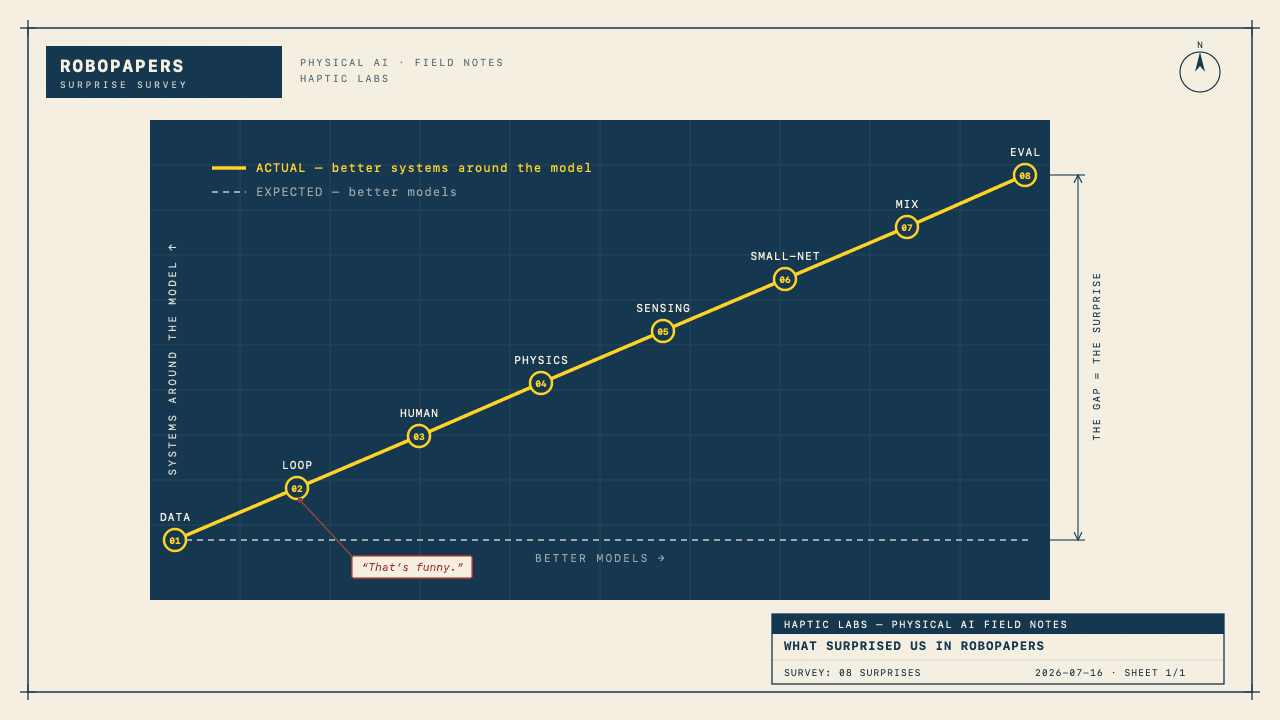
Below are the eight that most changed how we think. The number in parentheses is how many of the 64 episodes the pattern shows up in independently.
03 — Eight Surprises From the Frontier
- Data and tooling pipelines beat model novelty (9/64). The gains keep coming from curation, evaluation loops, reset automation, and system design, not from swapping the policy family. Robot Utility Models (Ep 2) said it flat out: the training data mattered more than the algorithm or the policy class. The public conversation over-indexes on architecture. The labs shipping results index on plumbing.
- Loops around the model beat bigger models (5/64). Generate candidates, judge them, retry: this keeps beating trust in a single forward pass. In Ep 2 a VLM judge plus retry lifted success from about 75% to about 90% at roughly 1.3 tries, with no retraining. NovaFlow (Ep 63) made zero-shot manipulation work through rejection sampling over generated flows, with a VLM picking the feasible one. Reliability comes from the decision loop, not only the generator.
- Human data transfers better than assumed (8/64). Egocentric video, wearables, and motion traces keep transferring to robot control once paired with the right representation. The assumption that real transfer needs robot-specific demonstrations at scale keeps not holding. Ep 63 runs manipulation zero-shot from generated human video, with no demonstrations at all.
- The visual sim-to-real gap is closing, and physics is now the bottleneck (5/64). GSWorld (Ep 56) reports zero-shot sim-to-real with vanilla Gaussian splatting, no domain adaptation and no real-world demos, and names the physics gap as the dominant failure that remains. PolaRiS (Ep 62) sharpens it: the visual gap that is left is not broken rendering but subtle statistics, the specularities, color grading, and missing shadows that look fine to a human and throw off a policy. The field spent years blaming the pixels. The pixels are nearly handled.
- More sensing can hurt (5/64). Ep 56 had to remove the wrist camera, because during RL exploration it produced too many out-of-distribution views. Project Instinct (Ep 64) found that capping perception at two meters beat three, because seeing further forced the policy to handle more terrain than it could learn. The default says add sensors. Disciplined sensor choices keep winning instead.
- Small models on cheap hardware keep delivering (6/64). Ep 2 ran roughly 80 MB policies in real time on a low-power onboard computer, with iPhones doing data collection and pose tracking. Ep 56 trained its sim-to-real visual RL agent on a single consumer 4090 in 10 to 20 hours. Strong robot performance is assumed to need large models and serious infrastructure. Episode after episode, it does not.
- Data quality and composition beat raw quantity (5/64). In Ep 2, mixing non-expert teleoperation data with expert data made policies worse than expert-only, and signs of generalization showed up at just 20 environments. In Ep 62, co-training on too much in-domain simulation data hurt the benchmark's ability to tell policies apart. “Just add more data” is still the default advice. The frontier keeps finding that the mix matters as much as the volume.
- Evaluation infrastructure is a bottleneck that looks like a product (4/64). Queued real-robot evaluation, distributed pairwise judging, real-to-sim benchmarks that actually track reality. PolaRiS (Ep 62) reports a 0.98 correlation with real-world RoboArena, and the authors are the first to call it “too nice” and “a somewhat happy coincidence,” which is the kind of honesty we trust. Evaluation used to be the reporting step at the end of a paper. Now it drives iteration speed. This is the surprise that rhymes hardest with pain point number six from March, evaluation and benchmarking at scale. When the same theme tops both lists, that is where we would dig.
There are seven more, from staged training pipelines to hardware timing outweighing the algorithm. They're all in surprises_global.md, with episode citations.
04 — The Meta-Surprise
The eight share one theme: physical AI's public story is about better models, but the wins in these episodes come from the system around the model, from the data going in and the loop wrapping the output to the hardware and the eval, seldom the model itself.
In March we noted that the bottlenecks were boring data plumbing more often than missing ideas. The surprises are the optimistic half of the same observation: the plumbing is where the wins are, and the wins are cheaper than expected, a retry loop here, a curation decision there, one fewer camera.
For builders, the highest-leverage areas keep repeating: data curation and composition, evaluation and benchmark infrastructure, sim-to-real physics and deployment reliability, and planning or search layers on top of generative models. If you have read anything else on this blog, you can guess why that list motivates us. It is roughly our roadmap.
The public story is about better models. The results are about better systems around them.
05 — What's Next
We will keep the repo updated as new episodes land, and keep publishing what we find, including deeper dives on single surprises, starting with the ones we have re-confirmed the hard way.
Stay tuned.
06 — We Want to Hear From You
We would love to hear from you if:
- One of these surprises contradicts your experience. The fastest way to reprice a belief is testimony from someone who paid for it. Tell us where we are wrong and save every reader after you.
- You are building where surprise meets pain, in evaluation infrastructure, data curation, or sim-to-real physics tooling. We want to compare notes.
- You caught an error. The pipeline is human and AI, so there may be mistakes. Open a PR on the repo and we will merge it and credit you.
Passion in the domain is more important than agreeing with us.
Reach out via email, X, or GitHub.
Special thanks to Chris Paxton and Michael Cho for the endless source of insights from their RoboPapers podcast.